Bearing walls and floors
Studs and tracks for bearing walls and shear walls; C-sections and joists for floors, in low- and mid-rise buildings designed to AISI S240-20.

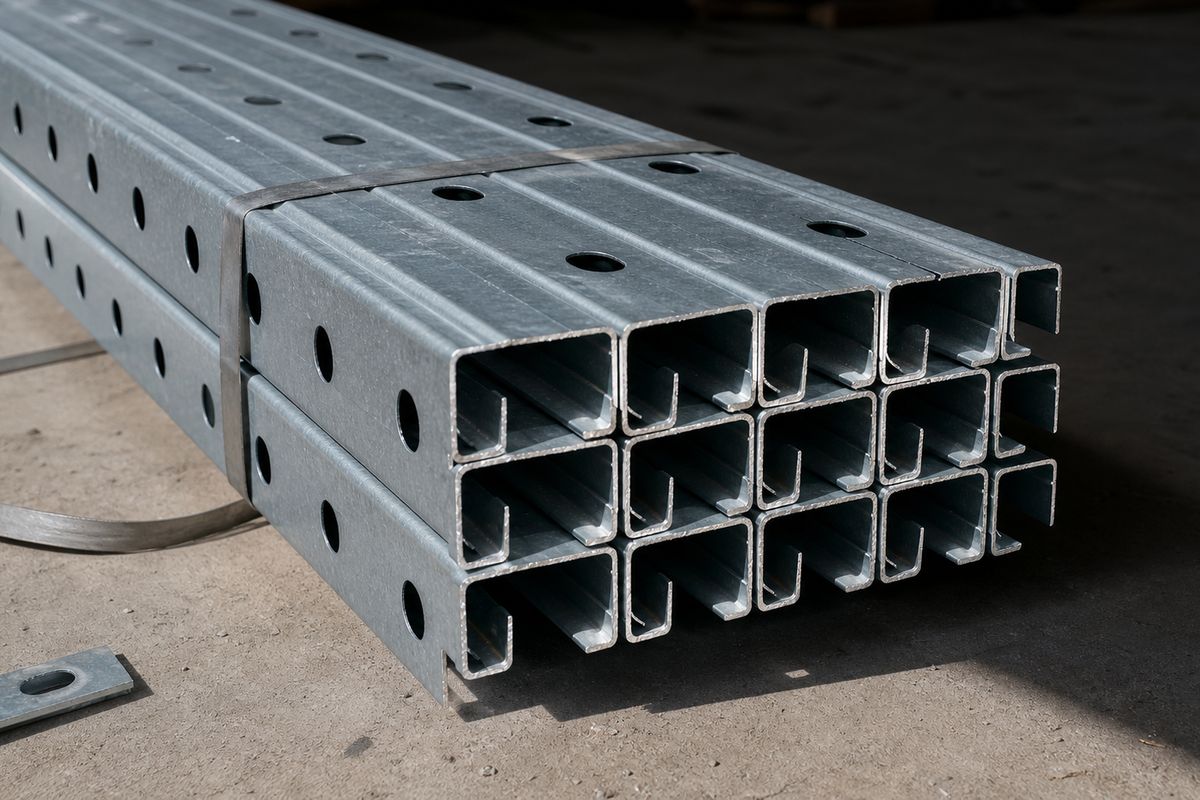
The structural profile, cut and punched straight from the model, ready to screw down. Quoted by linear meter or by ton.
NewCon Steel LGS/CFS profiles are cold-formed structural members roll-formed from coil with a zinc-aluminium-magnesium (Zn-Al-Mg) alloy coating at 275 g/m², available in thicknesses from 0.85 to 2.5 mm, CNC-cut, punched, marked and labeled to a ±0.5 mm dimensional tolerance, and designed to AISI S100-16 (R2020) with Supplement 3 (S3-22).
Cold-formed steel — light gauge steel (LGS) or cold-formed steel (CFS) — is thin steel sheet formed at ambient temperature into a structural section: studs, tracks, hat channels, C-sections and Z-purlins. It is not melted and it is not hot-rolled: it is bent. That is why thickness is specified in millimeters of sheet, not in the weight of a rolled section.
The practical consequence is twofold. First, design is governed by a different specification: AISI S100-16 (R2020) with Supplement 3 (S3-22), not the hot-rolled steel specification. Second, the piece can be made to exact dimension — cut, punched and labeled — because the process runs off a machine, not off a job shop.
NewCon Steel cold-forms on its roll-forming line at Centro Industrial PEB, Las Mañanitas, Panama City. Profiles come off the line at NewCon Steel's manufacturing dimensional tolerance of ±0.5 mm.
Every profile is cut to the length in the take-off, punched with its service penetrations and connection holes, marked and labeled with its shop-drawing identifier. On site the piece is set, aligned and fastened.
That removes three known sources of rework in generic stock-length steel: field cutting, laying out holes by hand, and touching up the coating on a saw-cut edge.
If you want the framing labor to leave the job site too, the same profiles ship pre-assembled as panels or as the complete structure in a kit.

Everything a structural engineer needs to decide whether they can specify us, and everything a buyer needs to compare offers without ambiguity.
Section dimensions and section properties for each family are issued in the project data sheet alongside the quote. Available sections and thicknesses can vary by production run: confirm them before you issue the order.
Table 1 of ASTM A1003 does not list Zn-Al-Mg alloy coatings: they qualify through the alternative, performance-evaluated coating route (ASTM A1004), which requires at minimum the corrosion behavior of a G60 for Type H and Type L structural steels. Our coating mass is 275 g/m² — more than 50% above that 180 g/m² minimum. We hand it to your specifier ready-checked — arithmetic you can verify against public standards.
Studs and tracks for bearing walls and shear walls; C-sections and joists for floors, in low- and mid-rise buildings designed to AISI S240-20.
Light gauge steel trusses and cold-formed roof purlins, with wind loads verified to ASCE/SEI 7-22 for the project's site.
Studs and tracks for interior partitions and facade subframing, carrying the same Zn-Al-Mg 275 g/m² coating as the structural profile.
Send drawings, the structural model or a quantity list by family, thickness and length. If you do not have a take-off yet, send the geometry and our team turns it into a piece list.
lm or tSheet thickness between 0.85 and 2.5 mm, Zn-Al-Mg coating at 275 g/m². If your specifier requires a different coating mass, say so before the quote.
ZM275You get a quote with quantities, thicknesses, coating, fabrication time and shipping terms, within 48 hours.
48 hRoll-forming, cutting, punching, marking and labeling by CNC at the Panama City plant, to a ±0.5 mm tolerance; bundled and shipped with mill certificate and certificate of origin.
±0.5 mmNewCon Steel manufactures LGS/CFS profiles in sheet thicknesses from 0.85 mm to 2.5 mm. Thickness is always specified in millimeters of sheet, never in gauge: gauge-to-millimeter equivalence shifts depending on which chart your specifier uses, so we issue it in writing in the project data sheet to keep ambiguity out of the purchase order.
NewCon Steel profiles are delivered cut to the take-off length, punched, marked and labeled by CNC, to a ±0.5 mm dimensional tolerance. They are not cut on site. Every piece carries its shop-drawing identifier, so the crew sets, aligns and fastens instead of measuring and cutting. That removes field cutting and it removes coating touch-up on a saw-cut edge.
NewCon Steel profiles use a zinc-aluminium-magnesium alloy coating at 275 g/m² (both sides), not pure zinc. The magnesium and aluminium migrate across cut edges, punch-outs and fastener points and form a protective film over the exposed steel — the point where conventional galvanizing gives out first. In real atmospheric exposure, peer-reviewed literature records 2 to 4 times lower mass loss than conventional hot-dip galvanized steel after 4 to 6 years, including marine sites; Nippon Steel separately reports 10 to 20 times better resistance in accelerated salt spray testing (JIS Z 2371). We always name the test, because a salt-spray cabinet is not a linear predictor of service life.
NewCon Steel does not impose a full-container minimum — the usual barrier when you buy cold-formed steel out of Asia: the production run is set against the project take-off. The commercial minimum that applies to your case is confirmed in the quote, based on profile family, thickness and shipping destination.
NewCon Steel LGS/CFS profiles are designed to AISI S100-16 (R2020) with Supplement 3 (S3-22), the North American Specification for the Design of Cold-Formed Steel Structural Members, and to AISI S240-20 when they form part of a framing system. Seismic design follows AISI S400-20 and loads follow ASCE/SEI 7-22. Final verification is run against the code of the destination country. Detail in engineering and standards.
Buying loose profiles from NewCon Steel makes sense when your crew frames on site and you want to control the pace of assembly. Buying pre-assembled structural panels makes sense when you want the framing labor off the job site: the wall, the floor cassette or the truss arrives assembled in the plant, numbered and sequenced to the structural model, and the crew simply lifts and fixes it. The material is the same profile; what changes is where the work happens.
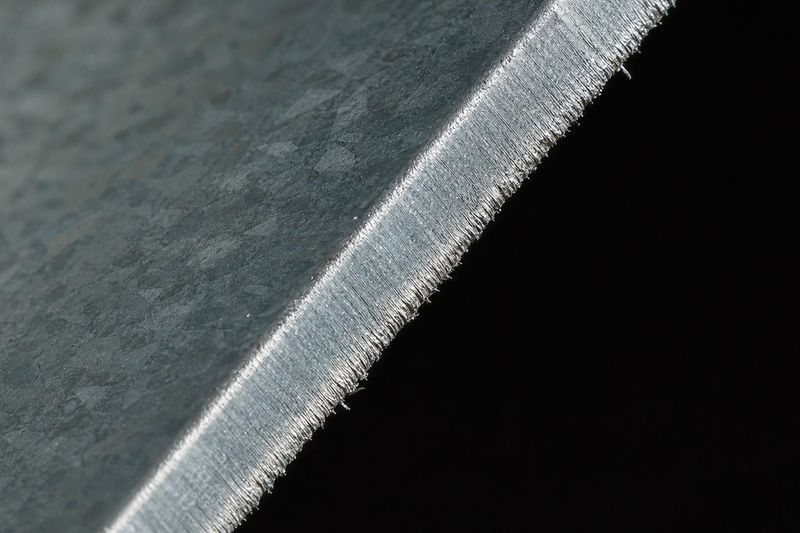
Coating, cut edge and service-hole punchings — the three details an engineer looks at before specifying.


Send the take-off, or quantities by family, thickness and length, plus the shipping destination. You get a formal quote within 48 hours.